




Wednesday, May 16, 2012
Requiem for a Secret Spot


Tuesday, February 7, 2012
Just Over the Rise
 As we moved up the trail, we made our way through a forest comprised of a variety of pines and cedars. The landscape was also artfully punctuated with colorful Aspens. Above us, the snow on the mountain acted as a beacon upon which we could both fix our position and navigate our way to the lake, which we knew was just over the next rise....
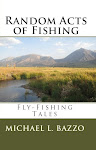
Read More in Random Acts of Fishing
Monday, January 23, 2012
Winter Fly Fishing

During the winter months, trout can be sluggish and hold deep in dark pools. Successful hunting at this time of year requires water that is dark, deep, and slow. Because bugs are not too active in cold weather, large trout will not come to the surface to take their meals but will scour the depths like submarines on the prowl. Of course, when the late morning temperature warms, a Mayfly hatch can be an explosive event. Don't be caught off guard without sufficient ammo such as BWOs in size 16 or 18, parachute adams, or even dark midges. If you're willing to brace the cold and prospect in the right areas, you'll rewarded with a memorable experience.
Sunday, January 9, 2011

Sunday, August 22, 2010
 There is a remote place amid the peaks of the high country where the air is crisp and clean, and the smell of pine is truly intoxicating. Where lakes appear as smooth as glass, like giant mirrors, reflecting cotton ball clouds gliding across their surface. A place where time stands still and the wind moves the tall grass to and fro in gentle waves. Only in this high country can be found fish so colorful that they resemble drops of liquid gold.....
Read more in Random Acts of Fishing
Friday, August 6, 2010
Confluence
 The dark water of the Upper Owens River meanders through an immense valley. Along it's course can be found innumerable bifurcations. The confluence of two or more branches most often makes for fertile hunting, as trout will linger and wait for food to come their way from either source.
In the photo above, the turbulent white water seen in the center of the image is the tell-tale demarcation of the joinder of the two currents. It forms a white line or "seam" between the two moving bodies of water. A fly placed at the upper end of the seam near the triangular point of land and allowed to float down the length of the line will surely cause a trout lurking there to rise. Additionally, if no response is achieved, a fly near the tale end or shortly after the confluence has flattened out, can be deadly too.

The fish to the right was taken from the seam in the above photo on an elk hair caddis, danced along the upper portion of the confluence near the point of land, and allowed to move down the seam. Irrisistible!
Next time you're fishing a meadow stream, be on the look-out for branches of the stream that come together and explore the confluence. You might just be surprised!
Sunday, July 18, 2010
Pandora's Box
 When considering the type of fly box that you wish to purchase, take time to think about all the other items you'll be carrying out on the water and what you're going to put them in.
I like using a vest. I started with one when I first took up fly fishing 37 years ago and have stuck with it. But the deciding factor for me in using a vest is more a product of where I fish and how I fish, not one of style. The majority of my fishing tends to involve hiking along rivers and streams in the Mammoth area. Rarely do I fish lakes, and when I do, they are high country lakes to which I have to hike a long distance. For that reason, a vest is extremely useful to carry not only fly boxes but a bottle of water, lunch, bug spray, survival knife, fire starting tools, and anything else that I might need to assist me on those long treks miles from the car. So, as one more necessary piece of equipment to shove in a vest pocket, consider the size, shape, and use of the fly box that you'll need.
I have multiple fly boxes, each loaded with different types of flies; boxes filled with terrestrials, boxes with nymphs, poppers, dries, etc. Of course, I don't take every box with me on every jouney. If you plan ahead, your can pare down your box of ammo to just the types of flies you'll need for the destination. On the last trip, I took with me one fly box supplied with only blue winged olives, elk hair caddis, bead head prince nymphs, and some larger stimulators. That's all I need to inflict a great deal of damage!
I like the cheap, green plastic foam-filled boxes. They float, seem indestructable, and have foam ridges on which to clip the flies. Some people like compartments; some like flies loose in one non-partitioned container. Try out some different styles. I have found that the compartments and the loose style do not work for me, as I have had flies blow out of a box in a strong wind once the compartment is opened. There is an argument that with a compartment box, you only open the compartment that you need. I get that too. The point is, experiment; try several different methods, and you'll discover what's best for you.
Subscribe to:
Posts (Atom)